
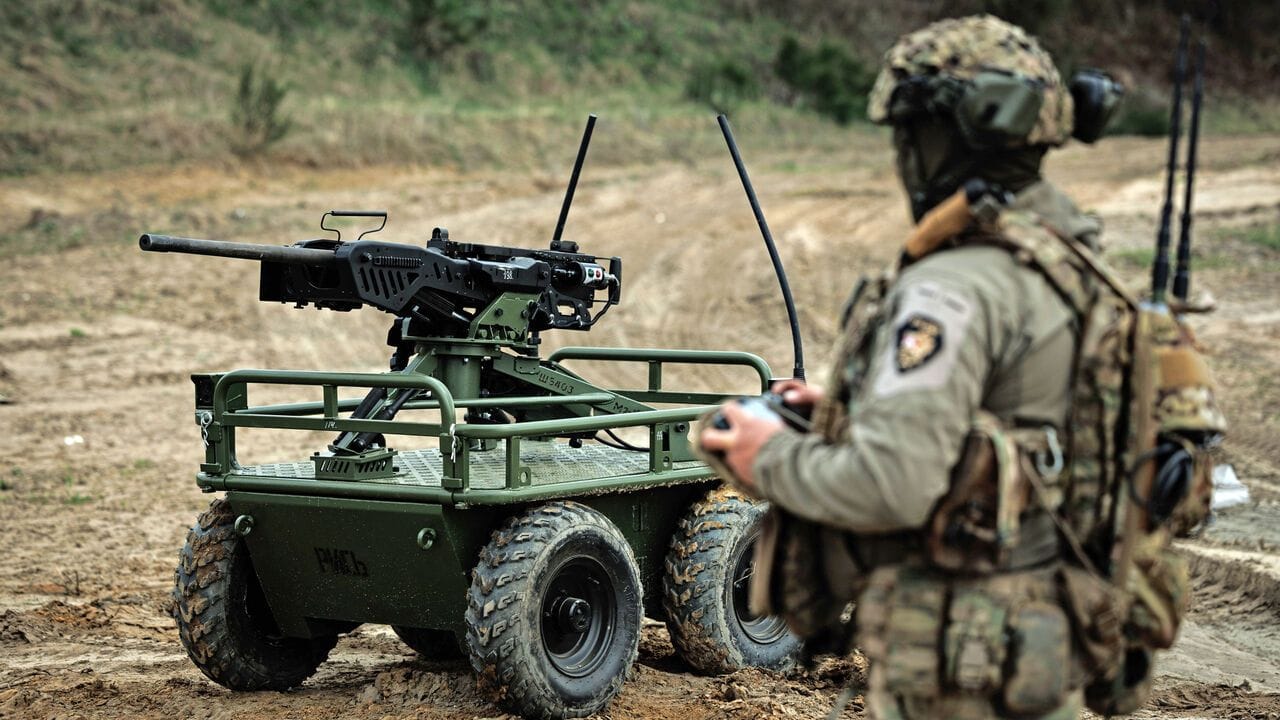
Ukraine just crossed a line that military strategists have been debating in theory for years. President Zelenskyy announced that Ukrainian forces seized a Russian position using nothing but ground robots and drones — no infantry, no casualties on the Ukrainian side, and Russian soldiers ultimately surrendering to machines. Seven robotic platforms participated. Over 22,000 robotic missions have been logged in the first three months of 2026 alone.
Even with the caveat that this claim hasn't been independently verified, the trajectory is undeniable. A war that redefined drone warfare is now pushing hard into the era of ground robotics, and the AI underneath these systems is already delivering measurable results — not in some Pentagon white paper, but in live combat.
What the AI Is Actually Doing Right Now
It's tempting to hear "AI on the battlefield" and picture Terminator. The reality is more specific, more interesting, and arguably more significant in the near term.
The clearest win is in navigation. Ukrainian FPV drones using autonomous terminal guidance — called "last-mile navigation" in Ukrainian military slang — are hitting targets at rates of 70 to 80 percent, compared to 10 to 20 percent for manually piloted systems. That's not a marginal improvement; it's a structural shift. You no longer need a steady radio connection or an elite pilot. A $50–$100 navigation module from a company called The Fourth Law, already in mass production, can do the work. The most deployed system, VGI-9, can track moving targets up to 80 km/h. Where you once needed eight or nine drones per target, one or two often suffice now.
Automatic target recognition has similarly jumped. AI models identifying tanks, artillery, vehicles, and infantry now operate effectively up to two kilometers out — up from roughly 300 meters not long ago. Ukraine's ZIR system packages this capability into a hardware module about the size of a soap bar, mountable across drone platforms and trained on publicly available data. In 2024, Ukraine procured 10,000 AI-enhanced drones for the first time, against a total production run of around two million. A small fraction, yes — but the procurement signals intent, not just experimentation.
Less glamorous but equally telling: the acoustic detection system Zvook identifies enemy drones by sound at distances up to 4.8 kilometers, feeds results into the Delta situational awareness platform within 12 seconds, and costs around $500 per station with a false alarm rate of just 1.6 percent. The text analysis platform Griselda, meanwhile, reportedly replaces 99 percent of human labor in processing intercepted Russian communications. Those figures come from the manufacturers themselves and lack independent verification, but even discounted, the direction of travel is clear.
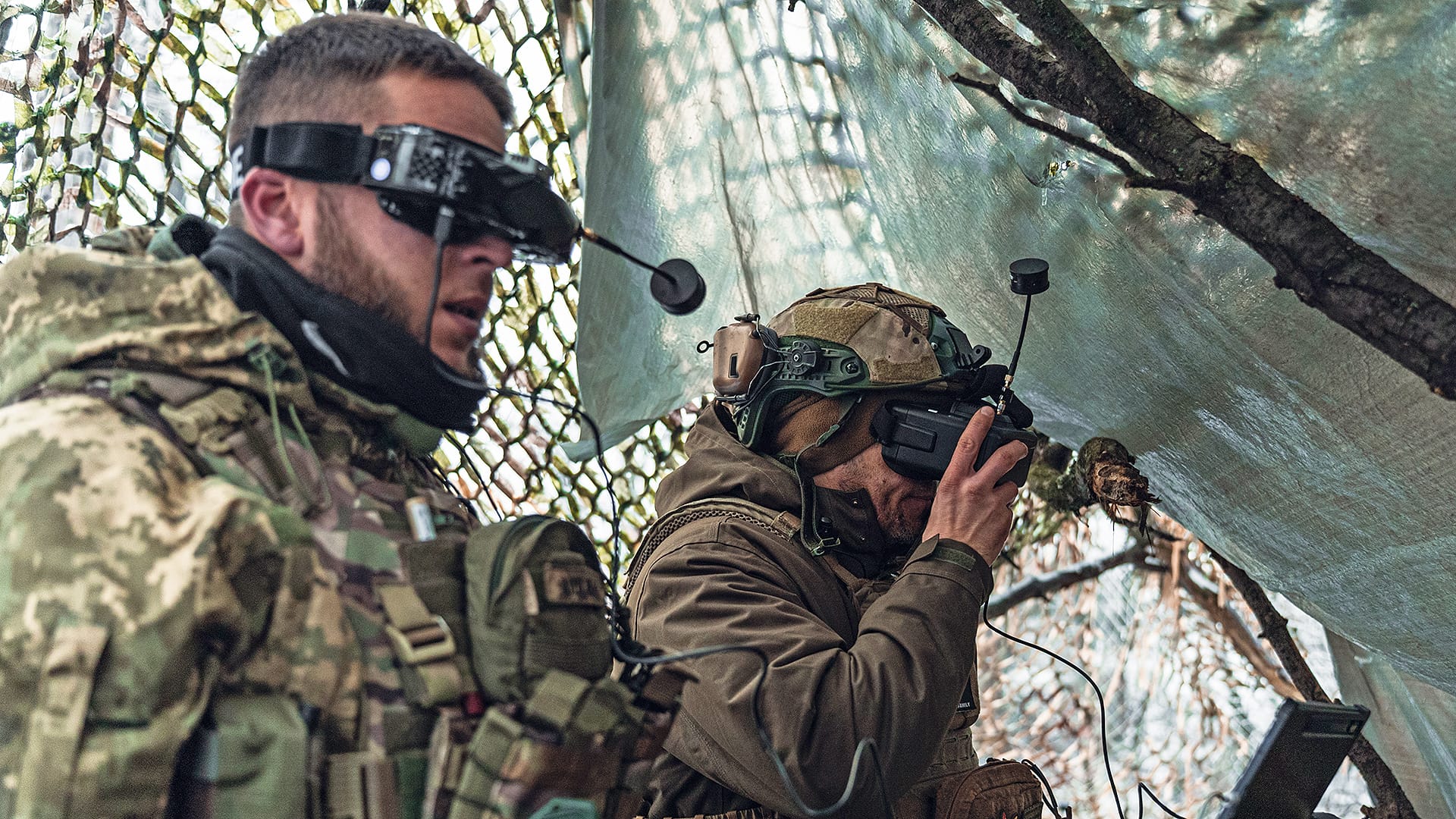
The architectural choice underlying all of this is worth noting. Ukrainian defense companies are deliberately building small, specialized models on lean datasets rather than pursuing general-purpose AI. These models run on cheap chips embedded directly in the hardware and can be retrained quickly. Encrypted software is treated as a strategic asset — adversaries can reverse-engineer hardware in weeks, but cracking software encryption buys time. Soldiers can be trained on these autonomous systems in 30 minutes to a day, a dramatic compression of the skill curve that previously made drone warfare an elite activity.
What the AI Cannot Yet Do
A CSIS report, drawn from dozens of interviews with Ukrainian military personnel and defense manufacturers, is careful to distinguish capability from hype. During the Lyptsi operation near Kharkiv in December 2024 — widely cited as a precursor to Zelenskyy's announcement — the ground robots were still manually remote-controlled. "Unmanned" is not the same as "autonomous."
True autonomy — systems that independently find, classify, and engage targets without human input — does not exist on Ukraine's battlefield. Ukrainian forces maintain a human-in-the-loop posture: operators can override autonomous functions at any time. All attack decisions remain with humans. Drone swarms, where multiple units communicate and coordinate independently, are still in early experimental stages. And the AI models themselves remain largely black boxes, a serious liability when the stakes are life and death.
Full autonomy, CSIS concludes, runs into technological, legal, and ethical walls simultaneously. That's not defeatism — it's an accurate map of where the hard problems actually live.
What This Means
This moment matters well beyond Ukraine, and the implications break differently depending on who you are.
- For developers and AI engineers: The battlefield is running small, fast, cheap, and specialized. The architecture choices Ukraine is making — lean models, edge inference, encrypted weights, rapid retraining — mirror what thoughtful engineers in constrained environments argue for everywhere. This is a live stress test of those principles at extreme stakes.
- For founders in defense tech: Ukraine has compressed the procurement and deployment cycle dramatically. A $50–$100 navigation module reaching mass production in a live conflict compresses the usual defense acquisition timeline by years. The lesson isn't just about drones — it's about what happens when iteration speed becomes a survival requirement.
- For the broader tech industry: This puts pressure on every major power's defense establishment to rethink how quickly AI capabilities can move from prototype to deployment. The US, China, and NATO allies are watching. Expect accelerated investment in autonomous ground systems and edge AI inference hardware.
- For policymakers and ethicists: Human-in-the-loop is the current answer to the autonomy question, but the CSIS report is honest that this boundary is technological as much as principled. As systems get faster and more capable, the practical window for human override shrinks. The governance frameworks don't exist yet.
The capture of a Russian position by machines, if confirmed at scale, isn't just a tactical milestone — it's a proof of concept that will be studied in every military academy on the planet. The question now isn't whether AI changes warfare. It's how fast the rest of the world catches up to what's already happening in eastern Ukraine, one robotic mission at a time.