
Meta's Latest Energy Gamble Literally Reaches for the Stars
Meta's appetite for electricity is no longer just an engineering problem — it's becoming a geopolitical and orbital one. The company has struck a capacity reservation agreement with Overview Energy, a four-year-old Virginia-based startup, to receive up to one gigawatt of solar power collected in space and converted into infrared light beamed down to terrestrial solar farms. The arrangement is remarkable for what it says about where AI infrastructure is headed: the grid alone can no longer keep pace.
To understand the scale of Meta's power problem, consider this: its data centers consumed more than 18,000 gigawatt-hours of electricity in 2024 alone — enough to run roughly 1.7 million American homes for a full year. And its AI buildout is nowhere near complete. The company has pledged to develop 30 gigawatts of renewable capacity, with industrial-scale solar at the center. But solar has a fundamental flaw that no amount of panels can fix: the sun goes down.
That's the exact gap Overview Energy is targeting. Rather than requiring new ground-based receivers or high-energy laser links — both of which carry serious safety and regulatory baggage — the startup's approach converts collected space solar into near-infrared light and beams it at existing solar farms on Earth. The logic is elegant: use infrastructure already built to absorb light and just... give it more light. CEO Marc Berte claims the beam is diffuse enough that looking directly at it causes no harm. That's a critical design choice, because anything resembling a weapon-grade beam would face an entirely different regulatory gauntlet.
How the Technology Actually Works
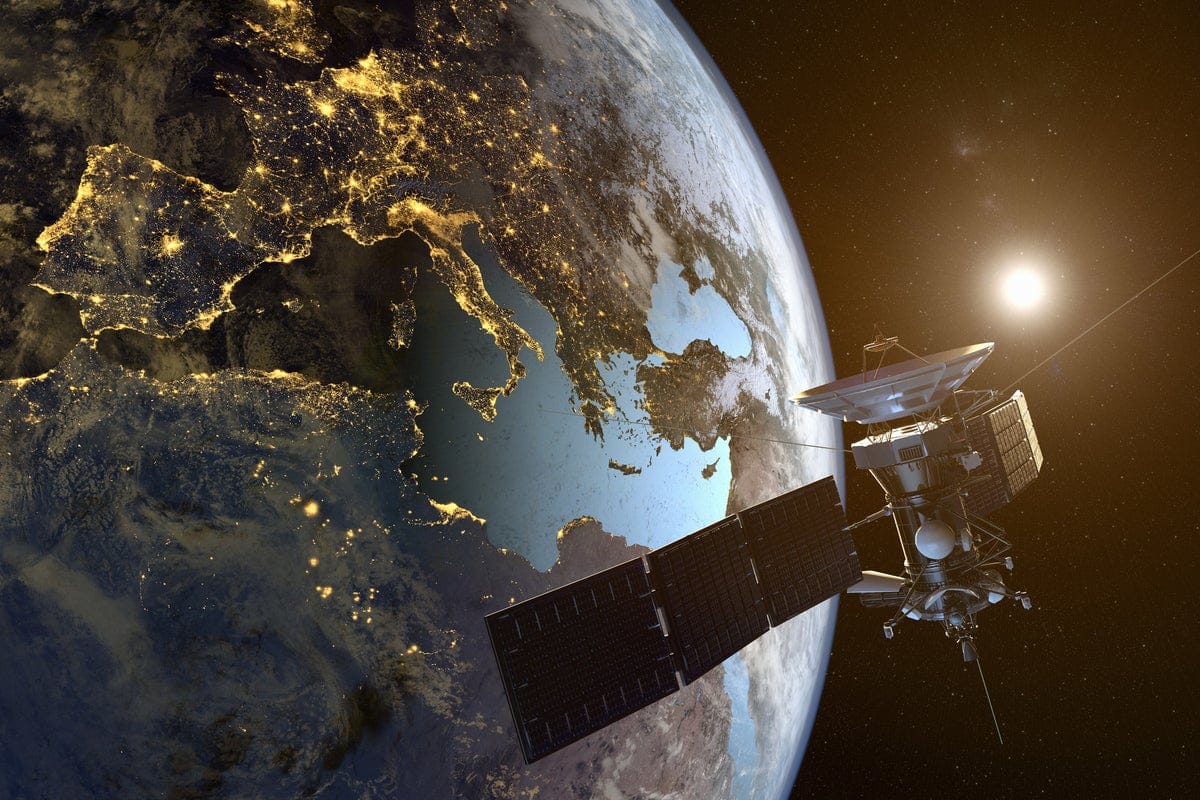
Overview plans to deploy roughly 1,000 spacecraft into geosynchronous orbit — the high-altitude band where satellites hover stationary above a fixed point on Earth. From there, a fleet covering about a third of the planet would be able to track solar farms as they rotate into darkness below, effectively extending their productive hours. The coverage at launch is projected to span from the U.S. West Coast across to Western Europe, which conveniently maps to where the bulk of Meta's data center footprint sits.
The company has already demonstrated power transmission from an aircraft to the ground, and a satellite demonstration in low Earth orbit is scheduled for January 2028. Commercial delivery at the scale needed to fulfill Meta's one-gigawatt reservation isn't expected before 2030, with Berte anticipating each spacecraft to operate for more than a decade once deployed.
To formalize the deal, Overview invented a new unit of measurement — "megawatt photons" — representing the amount of light required to generate a megawatt of electricity. Whether that metric catches on or quietly disappears will depend entirely on whether the technology delivers.
What makes Overview's pitch commercially interesting beyond the engineering novelty is its arbitrage potential across energy markets. Because the fleet can redirect beamed power to whichever solar farm is currently in darkness or under cloud cover, it isn't locked into serving a single grid. As Berte put it:
There's a big difference between being in any one energy market, and being in all of the energy markets.
That flexibility could command premium pricing — and would give Meta something rivals don't have: a controllable, weather-independent renewable source that doesn't require battery storage at scale.
The Inconvenient Reality Check
Let's be direct about what this deal actually is today: a bet on a technology that doesn't yet exist, placed by a company with the capital to hedge aggressively across multiple futures simultaneously. Meta's head of energy and sustainability framed the agreement as access to "uninterrupted energy" — but uninterrupted is doing a lot of work in that sentence when the satellites won't launch until 2030 at the earliest.
In the meantime, Meta is hardly sitting on its hands. The company recently backed construction of ten new gas-fired power plants to supply its massive Louisiana AI campus, and has made substantial investments in nuclear power including small modular reactor projects. Space solar is a long-horizon play layered on top of a very conventional near-term energy strategy. That's not a criticism — it's rational portfolio thinking for a company facing an existential power constraint — but it's worth naming clearly.
No financial terms were disclosed. Meta gets priority capacity access; Overview gets a marquee customer and, presumably, legitimacy that helps with future fundraising. Both parties benefit from the announcement regardless of whether a single watt ever gets beamed from orbit.
What This Means
The Meta-Overview deal isn't just a quirky moonshot story. It signals something structurally important about where the AI infrastructure race is heading.
- For developers and founders: Energy is now a first-order constraint on AI capability — not compute, not talent. Teams building the next generation of large models need to internalize that their roadmaps are implicitly dependent on power availability in ways that weren't true three years ago.
- For competing hyperscalers: Google, Microsoft, and Amazon are all facing the same solar-at-night problem. This deal puts pressure on them to either accelerate their own novel energy partnerships or double down on nuclear, where timelines are similarly stretched. Neither option is fast or cheap.
- For energy startups: Meta's willingness to sign a capacity reservation for technology that won't exist commercially until 2030 is a signal that large AI players will pay for optionality. If you're building unconventional clean energy infrastructure — geothermal, long-duration storage, orbital solar — the customer base is real and motivated.
- For regulators and policymakers: Space-based power transmission is about to move from theoretical white papers to actual orbital hardware. The regulatory frameworks governing what can be beamed from orbit to Earth simply aren't ready for this. That gap needs attention before 2028.
The deeper story here isn't really about satellites. It's about what happens when the energy demands of a technology grow faster than the grid's ability to supply it cleanly. Meta is spending billions to solve a problem that the entire AI industry shares — and it's willing to fund solutions that sound like science fiction if that's what it takes to keep the training runs going.
Space solar may or may not work at commercial scale by 2030. But the fact that a company with Meta's resources is treating it as a serious infrastructure bet tells you everything about how desperate and how serious the AI energy crunch has become.