The Problem With Brain Research
Neuroscience has always had a scaling problem. Every new experiment requires new subjects, new scans, and new hours inside an expensive MRI machine. The result is a field that moves glacially — fragmented by narrow studies, constrained by data scarcity, and perpetually bottlenecked by the cost of capturing ground truth.
Meta's FAIR lab thinks it has a way around this.
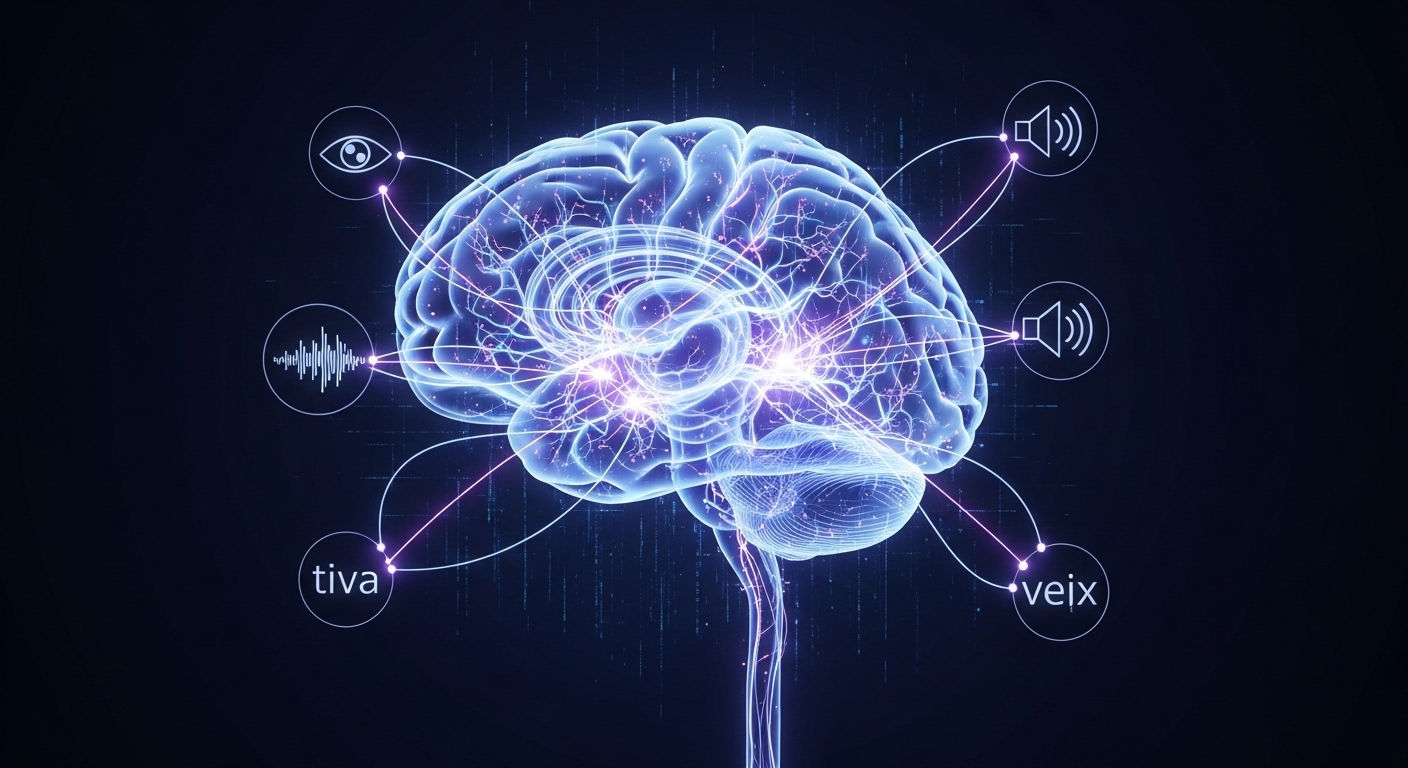
TRIBE v2 is a tri-modal foundation model that predicts how the human brain responds to video, audio, and text — without needing a single new scan. Trained on over 1,000 hours of fMRI data from 720 subjects, it maps predicted activity across 70,000 voxels of cortical and subcortical space. And in benchmark tests, it frequently outperforms actual human brain recordings.
That last point deserves to land properly: the model's predictions correlate more strongly with average group brain responses than most individual subjects' real scans do.
How It Works
TRIBE v2 doesn't learn to perceive the world from scratch. Instead, it piggybacks on the representational alignment that already exists between deep neural networks and the primate brain — a property researchers have been exploiting for years.
Three frozen foundation models handle feature extraction: LLaMA 3.2-3B processes text with up to 1,024 words of preceding context, V-JEPA2-Giant handles 64-frame video segments, and Wav2Vec-BERT 2.0 covers audio — all resampled to a common 2 Hz temporal grid.
A transformer encoder (8 layers, 8 attention heads) then processes all three streams together across a 100-second window, and a subject-specific prediction block maps the output to brain space. For new subjects with no prior recordings, a zero-shot pathway predicts the group-average response using only what the model already knows.
Why It Outperforms Real Scans
Individual fMRI scans are inherently noisy. Heartbeat artifacts, micro-head movements, and scanner drift all contaminate the signal. Getting a reliable picture of how a brain "typically" responds to something requires averaging many recordings across many subjects.
TRIBE v2 bypasses this by predicting the cleaned, averaged response directly. On the Human Connectome Project 7T dataset — which uses higher-field scanners than most labs can afford — TRIBE v2's zero-shot predictions achieved correlation with the group average roughly twice as high as the median individual subject.
Put differently: if you want to know how a human brain responds to a given stimulus, asking TRIBE v2 is often more informative than scanning an actual person.
Scaling Laws Enter Neuroscience
One of the more consequential findings isn't in the performance numbers — it's in the scaling curve. TRIBE v2's accuracy increases log-linearly with training data volume, with no plateau in sight. This is the same pattern that defines large language model development: more data, reliably better results, no ceiling yet visible.
This matters because fMRI repositories are growing. The UK Biobank, the Human Connectome Project, and a wave of open neuroimaging initiatives are accumulating data steadily. If TRIBE v2's scaling trend holds, the model gets meaningfully better as those databases expand — without architectural changes, without new training runs, just more data.
In-Silico Neuroscience Is Now Real
The most provocative application isn't prediction accuracy — it's what the researchers call "in-silico experimentation." The team ran TRIBE v2 against classical neuroscience protocols: isolated faces, places, bodies, and linguistic stimuli drawn from the Individual Brain Charting dataset.
The model correctly localized every major functional landmark: the fusiform face area, the parahippocampal place area, Broca's area for syntax, and the temporo-parietal junction for emotional processing. It even replicated the well-established left-hemisphere dominance for sentence processing over word lists.
These are findings that took decades of empirical research to establish. TRIBE v2 recovered them through digital simulation alone.
- For research planning, the implication is direct: you can now rough out an experiment on a computer, check whether your stimuli activate the regions you care about, and only commit to expensive lab time once the virtual result looks promising. That's a meaningful compression of the research cycle.
What This Means
- For neuroscientists: The bottleneck of data scarcity just got softer. TRIBE v2 doesn't replace empirical work, but it dramatically reduces the cost of piloting experiments and screening hypotheses. Expect faster iteration cycles in cognitive and clinical research.
- For AI researchers: The model's internal layers spontaneously organized into five known functional brain networks — auditory, language, motion, default mode, and visual — without being trained to do so. This has implications for building more neurologically plausible architectures and for understanding what representational alignment between brains and networks actually means.
- For the healthcare track: Meta explicitly lists brain disease diagnosis as a future use case. A model that can predict normative brain responses also has a natural application in detecting deviations — abnormal activations, missing functional networks, atypical lateralization. That's a longer road, but the foundation is there.
- For founders and builders: Meta open-sourced the code, weights, and an interactive demo. For anyone working at the intersection of health tech and AI, TRIBE v2 is both a research tool and an existence proof that foundation model thinking transfers to biological domains.
The Real Limitations
TRIBE v2 has real constraints worth naming. fMRI captures brain activity indirectly through blood oxygenation with a several-second lag — the fast-moving dynamics of neural computation at the millisecond scale are invisible to it. The model covers only three sensory modalities; smell, touch, and proprioception don't exist in this world.
More fundamentally, it models the brain as a passive receiver. There's no account of decision-making, motor output, or goal-directed behavior. It also can't capture developmental trajectories or clinical conditions yet — though Meta flags both as priorities.
These aren't fatal flaws so much as scope constraints. TRIBE v2 is a foundation model for a specific and well-defined task. The question is whether that task turns out to be foundational in a deeper sense: a substrate on which more ambitious neuroscience — and more brain-like AI — can be built.
Given the scaling trajectory, that seems like a reasonable bet. The full accompanying paper is available on Meta's research site.