
A Robot Walked Into the White House. It Wasn't a Joke.
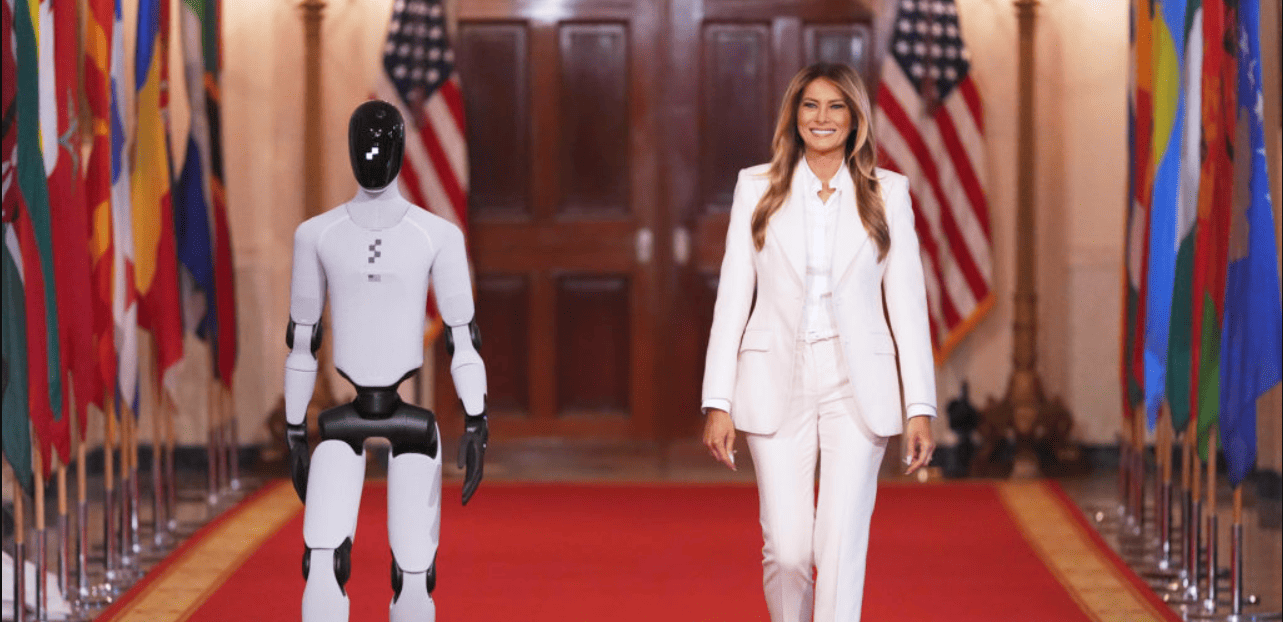
The image is genuinely strange: First Lady Melania Trump escorting a black-and-white humanoid robot down a red carpet in the White House's Eastern Room, as international dignitaries looked on. The machine introduced itself, expressed gratitude for the invitation, and then left the room — apparently done with its public duties.
It would be easy to dismiss the whole episode as a publicity stunt, and it partly was. But the thinking it represents is real, it has institutional backing, and it's moving faster than most people in education realize.
What Actually Happened
The event was framed as the "Fostering the Future Together" global summit, convened by the First Lady and attended by spouses of world leaders including France's Brigitte Macron and Ukraine's Olena Zelenska. The stated goal: exploring how advanced technology can support children's learning and development.
The robot — Figure 03, the third-generation humanoid from US robotics company Figure AI — was designed for general-purpose physical tasks, not education. Its presence was symbolic, meant to put a literal face on Melania Trump's central argument: that AI will soon migrate from our phones into humanoid bodies capable of delivering instruction directly to children.
Her specific vision had a name.
Imagine a humanoid educator named Plato. Access to the classical studies is now instantaneous — literature, science, art, philosophy, mathematics, and history — Humanity's entire corpus of information is available in the comfort of your home.
— Melania Trump, White House summit remarks
The pitch is personalized, patient, always-available AI instruction. It's also, notably, a pitch for replacing human teachers — or at minimum, making them optional.
This Isn't Just Optics
What gives the spectacle more weight than a typical publicity moment is the policy context surrounding it. The Trump administration has been systematically dismantling the Department of Education while simultaneously promoting AI-driven alternatives to traditional schooling.
Secretary of Education Linda McMahon recently visited Alpha School, a private network that uses AI to teach children at a rapid pace and compress instruction time. The administration praised the visit, framing it as a model for "preparing students for a rapidly evolving technology-driven workforce." Alpha School has attracted significant media attention over the past year as an early case study in AI-first education — and it now has the implicit endorsement of the administration overseeing (and shrinking) public schooling.
The pattern is deliberate: reduce federal investment in and oversight of traditional public education while lifting up private, tech-driven experiments as the future. The robot on the red carpet is the visual shorthand for that agenda.
The Technology Is Not There Yet
It's worth being direct about the gap between the vision and the reality. Figure 03 is a general-purpose robotics platform. It is not an educator. Current AI tutoring tools — even the best ones — struggle with consistency, hallucination, and the social-emotional dimensions of learning that human teachers handle instinctively.
Melania Trump's remarks were explicitly forward-looking, not a product announcement. But the rhetoric still matters because it shapes policy priorities and investment decisions. When the White House signals that humanoid AI instructors are the destination, capital follows.
The research on AI's effects on student learning is, at best, mixed. Educators have raised serious concerns that over-reliance on AI tools is eroding students' capacity for independent reasoning — the exact opposite of what the First Lady promised "Plato" would deliver. Those concerns went unaddressed at the summit.
The Edtech Industry Is Watching Closely
This puts pressure on edtech companies to sharpen their positioning. The administration is actively creating a policy environment friendlier to AI-in-education products. That's an opportunity — but it also means the sector is being asked to carry a larger ideological load than it may be ready for.
Companies building AI tutoring tools, adaptive learning platforms, or educational robotics now operate in a landscape where the federal government is simultaneously the biggest potential customer and the entity most aggressively dismantling the institutional infrastructure those tools would serve. That's a complicated market.
It also puts pressure on traditional educational publishers and learning management platforms. If the policy signal is "AI replaces teachers," and experiments like Alpha School get high-profile endorsements, the incumbents face questions about whether their model is aligned with where public money and attention are moving.
What This Means
- For developers building edtech: The White House is functionally doing your marketing — but the gap between the vision being sold and what your product can actually deliver is a liability. Overpromising in this environment carries real reputational risk when outcomes disappoint.
- For founders in AI and robotics: Figure AI just got a White House showcase for free. That's worth noting. The administration is actively recruiting the private sector into education, and the companies that move quickly into that space will have a structural advantage before any regulatory framework is in place.
- For educators and school administrators: The political pressure to adopt AI tools is increasing whether or not the pedagogical case is solid. Understanding what the current generation of tools can and cannot do — and being able to articulate that clearly — is becoming a core professional competency.
- For investors: The edtech sector has had a rough few years since the pandemic boom faded. An administration openly hostile to public education and enthusiastic about AI-driven alternatives is a meaningful tailwind for private players. The risk is regulatory and reputational — not commercial, at least in the near term.
The robot that walked down the White House red carpet is not teaching anyone's children right now. But the agenda it was deployed to represent is active, funded, and moving. The spectacle was designed to make an abstract policy vision feel inevitable. Whether it actually is depends on decisions being made in classrooms, boardrooms, and legislatures that have very little to do with humanoid robots — and a lot to do with what we decide education is actually for.