Google's Agentic Coding Tool Just Got a Lot More Serious
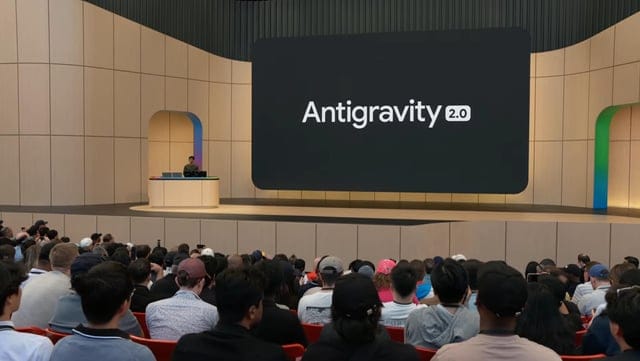
When Google launched Antigravity last year, it read more like a defensive move than a genuine product vision — a rushed answer to Cursor's growing dominance among professional developers. Antigravity 2.0, unveiled at Google IO 2026, is a different story. This release is deeper, more integrated, and architecturally ambitious in ways that should make the entire agentic coding market pay attention.
The headline feature is multi-agent orchestration: developers can now run several agents simultaneously inside the desktop app, designing custom subagent workflows and scheduling background tasks that execute without manual prompting. That's a meaningful leap beyond the single-thread, chat-style coding assistance most tools still offer. It signals that Google is building toward a model where Antigravity operates less like a smart autocomplete and more like a junior engineering team running in parallel.
The new release is powered in large part by Gemini 3.5 Flash — notably, a model that Google says was itself co-developed using Antigravity. That's a meaningful detail. It's Google's way of demonstrating that the tool has matured enough to eat its own cooking, which is the kind of proof point that resonates with skeptical developers more than any benchmark slide ever could.
A Full Platform, Not Just an App
What separates Antigravity 2.0 from a simple product update is the scope of its platform play. Google isn't just shipping a better editor — it's building an ecosystem.
The new Antigravity CLI gives terminal-native developers a way to build and run agents without touching a GUI. Significantly, Google is asking anyone currently using the Gemini CLI to migrate over, effectively consolidating its developer-facing command-line tooling under the Antigravity brand. That's a quiet but deliberate signal about where the company sees its coding infrastructure heading.
The Antigravity SDK goes further, letting developers build custom agents on top of Google's own coding infrastructure. Pair that with native Google Cloud connectivity and enterprise-ready agent templates in AI Studio, and you have the makings of a serious B2B pitch. Google Cloud customers can now wire Antigravity directly into their project pipelines — a clear play for the enterprise workloads that Cursor and GitHub Copilot are both chasing hard.
There's also a new export tool in AI Studio, which lets developers pull existing projects out of the cloud environment and continue working locally. That's a small but politically smart feature: it reduces the fear of lock-in, which is one of the most common objections enterprise buyers raise.
Native voice command support rounds out the feature set, extending the voice layer Google has been pushing across Gmail and Docs into the coding context. Whether developers actually want to dictate code is debatable, but the integration is consistent with Google's broader ambient computing thesis.
Pricing Gets Competitive — and Revealing
Google's updated pricing structure deserves a closer read than it usually gets in a product launch.
A new $100-per-month AI Ultra tier offers 5x higher usage limits compared to the Pro plan. The existing top-tier plan drops from $250 to $200, unlocking 20x the limits. That $200 price point now matches what Anthropic charges for Claude Max and aligns with OpenAI's top consumer tier as well.
This convergence isn't accidental. The $100 and $200 brackets have quietly become the de facto pricing ladder for serious AI power users, and every major lab has now settled into the same structure. What this tells you is that these companies have done enough usage analysis to know where the willingness-to-pay cliff edges are — and they're all landing in the same place.
For Google, the more interesting move is the $100 entry point into Ultra. It lowers the barrier for professional developers who want meaningful compute without committing to an enterprise contract, which is exactly the segment Cursor has been winning.
Antigravity in Search: A Glimpse of Something Bigger
One detail that got less attention than it deserved: Google is using Antigravity's capabilities inside Search itself. Users will be able to generate custom UIs in real time as part of search results and build lightweight mini-apps while exploring a topic — all within the search interface.
This is a preview of something genuinely novel. It collapses the distance between "looking something up" and "building something," which has implications well beyond the developer audience. If Google executes this well, Search stops being a directory and starts functioning like a low-code environment for anyone. That's a much larger ambition than beating Cursor.
What This Means
Antigravity 2.0 isn't a catch-up release anymore. It's a platform bid, and the ecosystem Google is assembling around it — Cloud integration, SDK, enterprise templates, Search embedding — is something no pure-play coding tool can replicate on its own.
- For developers: The multi-agent orchestration and CLI are the features worth evaluating immediately. If you're building complex, multi-step workflows, this is now a serious alternative to stitching together third-party agents.
- For founders building on Cursor or Copilot: Google's SDK and Cloud integration put direct pressure on any tool that relies on a standalone positioning. The question isn't whether Antigravity is better today — it's whether Google's distribution advantages make the gap irrelevant within 12 months.
- For enterprise buyers: The agent templates in AI Studio and native Cloud connectivity make Antigravity a credible option for standardizing agentic workflows at scale. The export tool is a meaningful concession to IT procurement concerns about lock-in.
- For the market broadly: The pricing convergence at $100 and $200 tiers across Google, OpenAI, and Anthropic signals that the "prosumer AI" segment is now well-defined and intensely competitive. Expect feature parity to increase and differentiation to shift toward ecosystem depth rather than raw model capability.
Google spent its first year with Antigravity establishing that it could build a viable coding tool. It's spending year two trying to make the category orbit around it.